Top 3 Calf Exercises With the Highest Muscle Activation
Calf training works best when you target both the gastrocnemius and soleus with a mix of straight-knee and bent-knee movements. Based on commonly cited exercise rankings, standing calf raises are usually the top choice for overall calf development, seated calf raises emphasize the soleus, and eccentric calf raises add a strong stretch-and-lower stimulus.
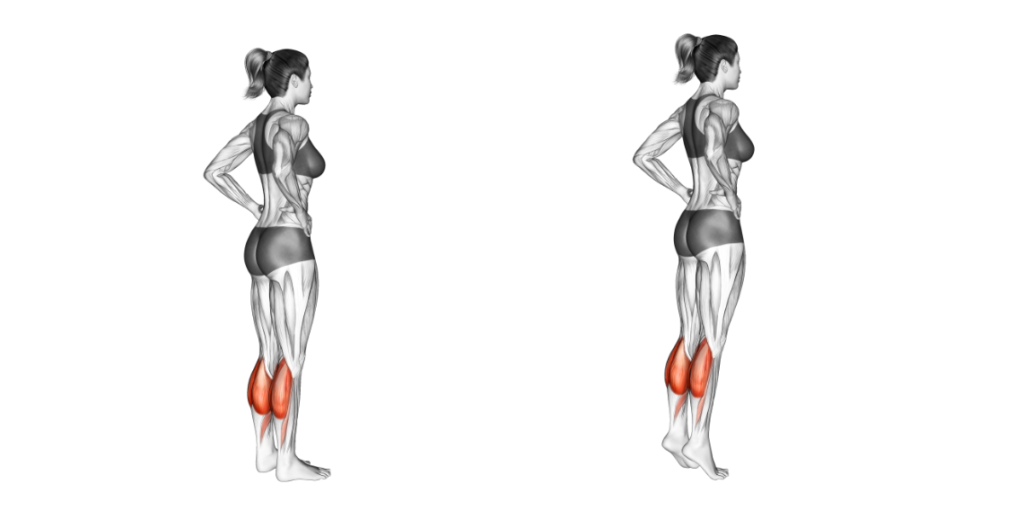
Top 3 by Activation
- Standing Calf Raise — best overall calf activation and the most common #1 choice for building calf size and strength.
- Seated Calf Raise — excellent for soleus emphasis and an important complement to standing raises.strengthlog+2
- Eccentric Calf Raise — strong for overload in the lowering phase and useful for muscle tension through a full range of motion.row.
Exercise Form Graphics
1) Standing Calf Raise
Form cue graphic:
- Stand tall on a step or flat surface.
- Keep knees mostly straight but not locked.
- Rise up through the balls of your feet.
- Pause at the top, then lower slowly until you feel a deep stretch.
2) Seated Calf Raise
Form cue graphic:
- Sit with knees bent and pads resting above the thighs.
- Press through the forefoot and lift the heels.
- Hold briefly at the top.
- Lower under control to fully lengthen the calves.
3) Eccentric Calf Raise
Form cue graphic:
- Rise with both feet or one foot.
- Spend extra time on the lowering phase.
- Move through a full range without bouncing.
- Use slow, controlled tempo to increase tension.
Full SEO Blog Post
Best Calf Exercises for Muscle Growth
If your goal is bigger, stronger calves, you need exercises that challenge the calves through full range of motion and different knee positions. Standing calf raises are a staple because they heavily load the gastrocnemius, while seated calf raises bring the soleus into play. Eccentric calf raises add another valuable stimulus by emphasizing the lowering phase, which can increase overall muscular tension.
Why Calf Activation Matters
Higher muscle activation does not automatically guarantee growth, but it is a helpful sign that an exercise is challenging the target muscle effectively. The best calf routine usually combines straight-knee and bent-knee work so both major calf muscles are trained. That is why a two-exercise or three-exercise approach often works better than doing only one variation.
1. Standing Calf Raise
Standing calf raises are often considered the best overall calf builder because they are simple, progressive, and effective. They are especially useful for the gastrocnemius, which contributes much of the visible calf shape. For best results, use a controlled tempo, a full stretch at the bottom, and a hard squeeze at the top.
2. Seated Calf Raise
Seated calf raises shift more emphasis to the soleus because the knees are bent. This makes them a strong companion movement to standing calf raises, rather than a replacement. If you want balanced calf development, this exercise should be in your weekly routine.
3. Eccentric Calf Raise
Eccentric calf raises are especially useful when you want more stretch and time under tension. The lowering portion is where you can build control and reinforce a stronger range of motion. This variation is also popular in rehab and performance settings because it helps train tissue tolerance and elasticity.
Best Calf Workout
A simple calf workout can look like this:
- Standing calf raise: 4 sets of 10–20 reps.
- Seated calf raise: 4 sets of 12–20 reps.
- Eccentric calf raise: 3 sets of 8–12 reps with a slow lowering phase.row.
Train calves 2 to 3 times per week, and use a full range of motion with controlled reps. Including different foot angles can also help you recruit the calves more thoroughly.
FAQ
What calf exercise has the highest activation?
Standing calf raises are the most commonly ranked #1 calf exercise for overall activation and growth emphasis.
Are seated calf raises better than standing calf raises?
They are not better overall, but they are better for emphasizing the soleus because the knees are bent. Standing raises remain the stronger all-around choice for overall calf development.
How many calf exercises should I do?
A practical plan is 1 to 3 exercises per session, with standing calf raises as the main movement and seated or eccentric variations as accessories.
How often should I train calves?
Training calves 2 to 3 times per week is a common recommendation for consistent progress.
Should I use high reps for calves?
Yes, calf training often responds well to moderate-to-high reps, especially when you control the lowering phase and use a full stretch.
Conclusion
If you want the best mix of activation, growth potential, and practicality, start with standing calf raises, add seated calf raises, and finish with eccentric calf raises. That combination covers the calves from multiple angles and gives you a simple, effective structure for better lower-leg development.